





Blog · Game UX
The best tutorial is the one players don't know about and how GoW got it right
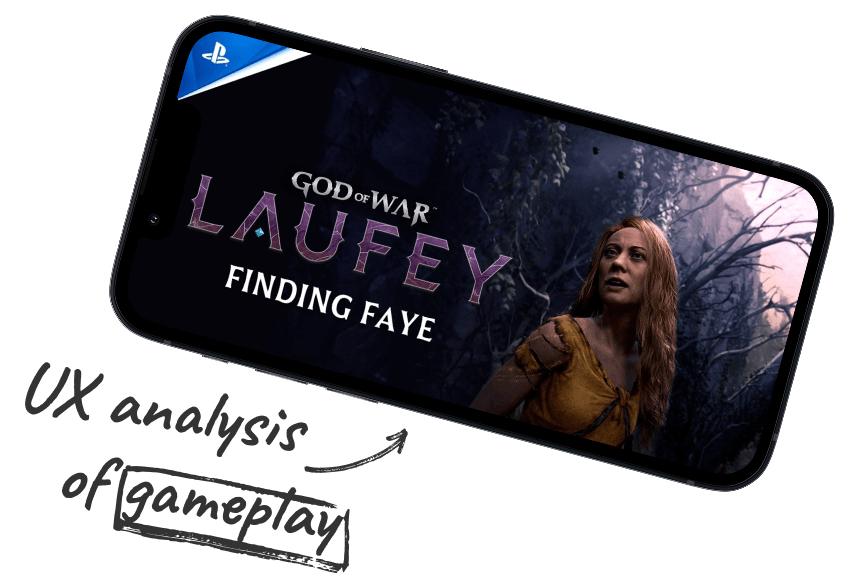
I was thrilled to see a new title from the God of War universe. A new protagonist is a logical continuation of the story — one that could confirm or deny a few theories and set up the titles to come. I could talk about my fascination with the rich story, the fluid combat, or the beautiful graphics, but what I found fascinating was the players' great onboarding UX.

A slow start, and a connection to previous titles
The opening gameplay takes us back to a scene we know from the first game of the new era, where Kratos and his son lay their wife and mother on the funeral pyre. We watch her spirit leave the body and travel to the afterlife. We see Faye lying unconscious, peaceful on the ground. And here comes a great decision: the game begins while the player is already in control.
The first interaction is to wake Faye up, and the tone and sound immediately change. Faye has died, and now she is the one being woken — on the other side. She mentions Kratos and Atreus, which further cements our connection to the protagonists of the previous game. Glowing runes on her body tell the player she can use magic.
At first, as she stands and then walks, she feels dizzy and unwell — again supported by the vignette and the sound. Waking up in the afterlife is not pleasant. The camera pans around her so the player gets a cinematic view of the environment, then settles on a gate in the distance, the one Faye traveled through.
She then looks at her hand, the music shifts again, and we see that something is stuck in it. It gets explained later in the game, but it's a great little hook: the player notices it now and feels rewarded when they find out what it is.

The best guidance is the kind the player never notices
Faye mentions several times that she doesn't know where she is — a quiet way of reassuring the player that they'll probably discover it by playing later on. It's a very simple tool for exposing the narrative without over-describing it.
The whole time, the only UI we'd seen was the prompt to start the game. Once the character starts moving, a health bar appears, filled only to half, so the player understands both where it sits and that the character is unwell.
After that there's a bit more exposition and a simple corridor with some obstacles to jump over, so the player eases into the controls at their own pace, without a dedicated tutorial. The next sequence was the moment I thought to myself: I want to write this article.
Faye enters an arena-sized part of the map. Experienced players will know what's coming; beginners will learn this piece of game design. She spots a mask and stares in disbelief — because, as we know from the previous game, the mask is powerful, the very thing the main antagonist spent the whole story chasing. The item crumbles to dust, but not before the music changes dramatically. We see vines move, and then she's attacked.

The player is again prompted to press a button, keeping them in charge while they learn the basics. We see Faye use magic, something her character design had already hinted at. She grabs a convenient sword from one of the corpses and faces the enemy she can hear. We can tell she's a capable fighter, but she has trouble casting her magic. Something is blocking her — reinforced by her voice-over: "This shouldn't be that difficult."
A third enemy attacks shortly after. The first two were an immediate threat, so a beginner probably mashes buttons to defend themselves. The delay between waves helps the player calm down and use the buttons they now understand.
After defeating the "tutorial" enemies, the friendly creature she saw before points her toward some armor, backed up by a visual cue and her voice-over. I can imagine that if we tried to leave the arena, she wouldn't want to go without it. It plants the idea that she's a warrior, and that there's probably a system of items that can make the player more powerful.
The dressing animation is clever. Animating a character putting armor on is expensive, so the camera pans behind her back — we see her picking up pieces but never an actual piece going on. It saves work, yet still gives the player the illusion of looting new equipment.
Then the player is prompted to crouch: the path is blocked by destructible vines, and later by more crouching, to really get it into the muscle memory. Everything is delivered one piece at a time, so the player is never overwhelmed.
The big bad(s) arrive
The music and the atmosphere change, and we're confronted by a strange enemy that isn't so easy to defeat. We follow her gaze to a pair of huge statues which, as we discover later, probably depict the main antagonists. Faye tries to use her magic; we see her care for animals, and that's what helps her channel it.
This draws the attention of the character the statues depict, and the music changes dramatically again. We hear foreign chanting from far-off lands. A different theme introduces the second character we glimpsed a moment ago — another foreign-looking figure. Her Egyptian ornamentation is clear, and from the fiery monster we can connect the dots that he comes from India or southern Asia.

The Egyptian character uses exposition to tell the player more about the mask and how Faye meant to use it to return to the plane of the living. We might have learned more, but they're interrupted by a ray of light that takes their attention.
The player is thrown into a cage, and while exploring it meets a strange cube and a talking sword — which is actually a talking ribbon holding a sword. They're friendly, give us verbal help, and help us channel magic.
We later see Kratos, announced by his theme song, but he disappears very quickly. Again, it helps the player connect, and it's a nod to a beloved character. Players speculate that he's briefly in the afterlife when he dies, before being resurrected by Thor. If that's true, it could hint at how time passes on the other side.
Then the environment tells the player to jump and use the metal object wrapped in red rope (the famous yellow-paint trick) to climb up. We're in an arena-sized environment again, but now with the sword's help. The player has gained power through the sword and can use more moves. I expect this will be explained with modal windows showing animated movement and highlighted buttons. Faye fights the bad guy — a common theme in GoW games, where we open against what's probably the main antagonist, but somehow escape, or the fight gets postponed by other means.

Final thoughts
This was an absolutely great intro for the game, because it used every trick to make the player feel in control, teach them how the game works, and establish the story. The player's perception is guided by music, the character's voice-over, visual hints in the environment, and subtle UI nods. We learn by doing and interacting, not by reading a tutorial.
It all looks effortless, and in hindsight it seems obvious, but it takes a lot of effort and crystal-clear communication across every level of game design: blocking out the level, sculpting the environment, character design, combat, the sound department. Everyone has to be on board to deliver this kind of onboarding. Either you win the player over, or they put the controller down in frustration and maybe never come back to the game.
If this got you thinking about game UI, I wrote a Witcher IV case study that goes deeper into the interface side of things.